Buying Guides · uppdaterad 2026-10-16
Hur långt kan ett säkerhetskamera se? Linser, upplösning och nattsikte förklarat
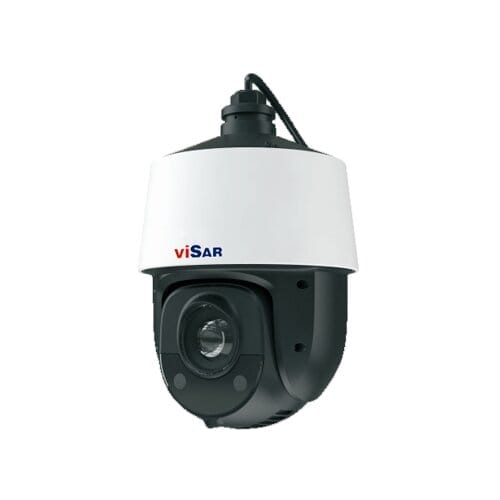
Hur långt kan en övervakningskamera se? It is the first question most people ask about a new camera — and the honest answer is that it depends on three things working together. A camera’s useful range is set by its lins (synfält och brännvidd), dess upplösning (hur mycket detalj som hamnar på varje meter av scenen) och, efter mörkrets inbrott, dess infraröd nattvisionräckvidd. Få dessa tre rätt för din plats och en kamera gör sitt jobb; få dem fel och du hamnar med klar filmmaterial av en bil du inte kan identifiera. Här är hur du bör tänka på var och en.
Synfält kontra avstånd: linsavvägningen
Varje lins tvingar en avvägning mellan hur wide den ser och hur far it sees usefully. A short focal length (say 2.8 mm) gives a wide visningsvinkel — great for covering a whole driveway or room, but distant objects shrink fast. A longer focal length (6 mm, 12 mm or more) narrows the view and magnifies the scene, letting you read detail much further away at the cost of coverage. So the question “how far can a security camera see” never has a single answer: a 2.8 mm lens might give a usable, identifiable image to roughly 10 m, while a 12 mm lens on the same sensor pushes recognisable detail out to 30 m or more within a narrower cone. Varifocal and PTZ cameras let you dial this in on site.
Upplösning handlar egentligen om pixlar-på-mål
More megapixels do not automatically mean “sees further” — what matters is how many pixels fall on the thing you care about, usually measured in pixels per metre (PPM). The security industry uses rough PPM bands: around 25 PPM to simply detektera that something is there, about 62 PPM to känna igen a known person, and 125 PPM or more to identifiera a stranger. A 4 MP camera spreads more pixels across the scene than a 2 MP one, so it holds identification-grade detail further out — but only within the area its lens covers. If you are weighing sensor resolution, our guide on hur många megapixlar du egentligen behöver bryter ned banden med exempel.
Night range: infrared and the “IR cliff”
In daylight, range is a lens-and-resolution question. After dark it becomes a lighting question. Most cameras rely on built-in infrared (IR) LEDs, and makers quote an “IR range” — 30 m, 50 m, 150 m and so on. Treat that figure as a best case: IR falls off sharply with distance (the den omvända kvadratlagen), so a subject at the very edge of the rated range will look dim and grainy. Wide-angle lenses spread IR thinly too, shortening effective night reach. If colour after dark matters, spotlight or full-colour cameras change the picture entirely — our explainer on infraröd kontra färg nattvision täcker när var och en är värt det.
Väder, montering och den verkliga världens gräns
Two identical cameras can have very different range on site. Rain, fog and dirty glass scatter both light and IR; a camera aimed into a bright streetlight blooms and loses distant detail. Mounting height and angle matter as well — too high and you capture the tops of heads, not faces. An exposed long-range camera also has to survive the elements, which is where our guide on IP-graderingar och väderbeständighet kommer in.
Matchande räckvidd till jobbet
Work backwards from what each camera must achieve. For a gate or till where you need to identify faces, choose a longer lens and enough resolution to hold ~125 PPM at that distance. For a general overview of a yard, a wide 2.8 mm camera is fine — just do not expect to read a number plate at the far fence. For long driveways or perimeters, a varifocal or PTZ model lets you zoom in on install. Browse weather-rated IP-kameror och PoE-kameror, eller planera ett fullständigt system från videoövervakaningsvägen.
Den korta versionen: hur långt kan en övervakningskamera se?
A camera’s range is a balance of lens (wide vs. far), resolution (pixels-on-target) and night-vision reach — bounded by weather and mounting. So how far can a security camera see in practice? As far as the job needs: decide the avståndet och uppgiften (detektera, känna igen eller identifiera) för varje position först, välj sedan lins och upplösning som levererar det. Det är hur du undviker filmmaterial som visar allt utom den detalj du faktiskt behövde.
 Buying GuidesMotion Detection Zones and Privacy Masks: Setup Guide
 Buying GuidesSecurity Cameras for Holiday Homes and Cottages: Setup Guide
 Buying GuidesSecurity Cameras in Winter: Cold Weather Tips and Fixes