Buying Guides · aktualisiert 2026-10-16
Wie weit kann eine Sicherheitskamera sehen? Objektive, Auflösung und Nachtsichtreichweite erklärt
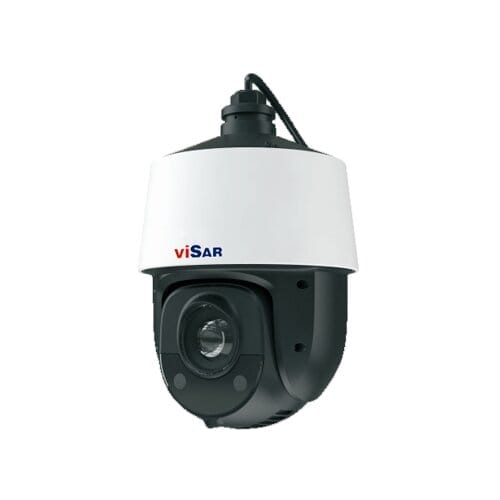
Wie weit kann eine Sicherheitskamera sehen? It is the first question most people ask about a new camera — and the honest answer is that it depends on three things working together. A camera’s useful range is set by its Objektiv (Sichtfeld und Brennweite), ihre Auflösung (wie viele Details pro Meter der Szene erfasst werden) und nach Einbruch der Dunkelheit durch ihre Nachtsichtreichweitebestimmt. Wenn Sie diese drei Faktoren für Ihren Standort richtig einstellen, leistet eine Kamera ihre Aufgabe; stellen Sie sie falsch ein, erhalten Sie gestochen scharfe Aufnahmen eines Autos, das Sie nicht identifizieren können. So denken Sie über jeden Faktor nach.
Sichtfeld vs. Distanz: der Kompromiss des Objektivs
Jedes Objektiv zwingt zu einem Kompromiss zwischen der Breite und der Entfernung, in der es sinnvoll sieht. Eine kurze Brennweite (z. B. 2,8 mm) bietet einen großen wide es sieht und wie far it sees usefully. A short focal length (say 2.8 mm) gives a wide Sichtwinkel — great for covering a whole driveway or room, but distant objects shrink fast. A longer focal length (6 mm, 12 mm or more) narrows the view and magnifies the scene, letting you read detail much further away at the cost of coverage. So the question “how far can a security camera see” never has a single answer: a 2.8 mm lens might give a usable, identifiable image to roughly 10 m, while a 12 mm lens on the same sensor pushes recognisable detail out to 30 m or more within a narrower cone. Varifocal and PTZ cameras let you dial this in on site.
Auflösung geht wirklich um Pixel-auf-Ziel
More megapixels do not automatically mean “sees further” — what matters is how many pixels fall on the thing you care about, usually measured in pixels per metre (PPM). The security industry uses rough PPM bands: around 25 PPM to simply Erkennen that something is there, about 62 PPM to Wiedererkennen a known person, and 125 PPM or more to Identifizieren a stranger. A 4 MP camera spreads more pixels across the scene than a 2 MP one, so it holds identification-grade detail further out — but only within the area its lens covers. If you are weighing sensor resolution, our guide on wie viele Megapixel Sie wirklich benötigen die Bereiche mit Beispielen.
Night range: infrared and the “IR cliff”
In daylight, range is a lens-and-resolution question. After dark it becomes a lighting question. Most cameras rely on built-in infrared (IR) LEDs, and makers quote an “IR range” — 30 m, 50 m, 150 m and so on. Treat that figure as a best case: IR falls off sharply with distance (the Abstandsquadratgesetz), so a subject at the very edge of the rated range will look dim and grainy. Wide-angle lenses spread IR thinly too, shortening effective night reach. If colour after dark matters, spotlight or full-colour cameras change the picture entirely — our explainer on Infrarot vs. Farb-Nachtsicht behandelt, wann jeweils lohnenswert ist.
Wetter, Montage und die reale Grenze
Two identical cameras can have very different range on site. Rain, fog and dirty glass scatter both light and IR; a camera aimed into a bright streetlight blooms and loses distant detail. Mounting height and angle matter as well — too high and you capture the tops of heads, not faces. An exposed long-range camera also has to survive the elements, which is where our guide on IP-Schutzarten und Wetterschutz relevant ist.
Reichweite an die Aufgabe anpassen
Work backwards from what each camera must achieve. For a gate or till where you need to identify faces, choose a longer lens and enough resolution to hold ~125 PPM at that distance. For a general overview of a yard, a wide 2.8 mm camera is fine — just do not expect to read a number plate at the far fence. For long driveways or perimeters, a varifocal or PTZ model lets you zoom in on install. Browse weather-rated IP-Kameras und PoE-Kameras, oder planen Sie ein vollständiges System aus dem Videoschutzbereich.
Die Kurzfassung: Wie weit kann eine Sicherheitskamera sehen?
A camera’s range is a balance of lens (wide vs. far), resolution (pixels-on-target) and night-vision reach — bounded by weather and mounting. So how far can a security camera see in practice? As far as the job needs: decide the Entfernung und die Aufgabe (Erkennen, Wiedererkennen oder Identifizieren) für jede Position, wählen Sie dann das Objektiv und die Auflösung aus, die diese liefern. So vermeiden Sie Aufnahmen, die alles zeigen außer den Details, die Sie wirklich benötigten.
 Buying GuidesMotion Detection Zones and Privacy Masks: Setup Guide
 Buying GuidesSecurity Cameras for Holiday Homes and Cottages: Setup Guide
 Buying GuidesSecurity Cameras in Winter: Cold Weather Tips and Fixes