Buying Guides · actualizado 2026-10-16
4K vs 2K vs Full HD: How Much Camera Resolution Do You Really Need?
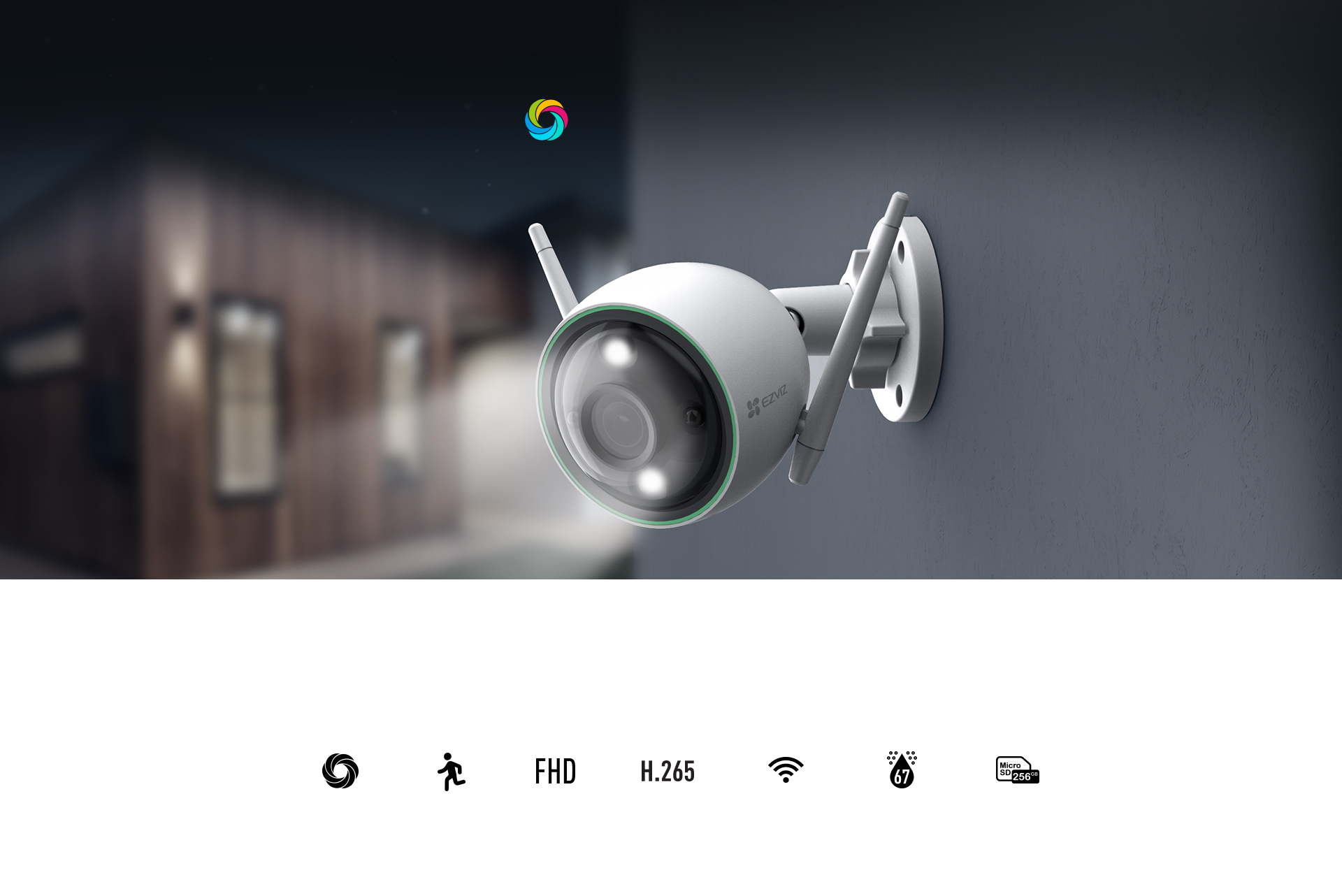
4K, 2K, Full HD — camera boxes shout numbers at you, but resolution is only useful if you know what it buys you in real footage. Here is what the numbers actually mean at night, at a distance, and on your storage bill.
What the labels mean
Full HD (1080p) is about 2 megapixels, 2K (1440p) is 4–5 MP, and 4K (2160p) is 8 MP. Each step roughly doubles the amount of detail in the frame. That matters for one thing above all: how far away a face or a number plate is still recognisable.
The identification distance rule
As a practical rule of thumb with a standard lens: a 2 MP camera identifies a person reliably up to roughly 5–8 metres, 4–5 MP stretches that to 10–15 metres, and 8 MP (4K) keeps faces usable at 20 metres and beyond. If your camera watches a doorway three metres away, Full HD is honestly enough. If it overlooks a driveway or yard, the extra pixels are what let you zoom into the recording afterwards and still see something useful.
Digital zoom is where 4K earns its keep
Optical zoom changes the lens; digital zoom just crops the image. Cropping a 2 MP frame quickly turns faces into mosaics, while cropping an 8 MP frame still leaves a sharp image. Since most real investigations happen after the fact — scrubbing through recordings and zooming in — resolution is effectively your zoom reserve.
Night time levels the field
In darkness every sensor collects less light, and more pixels on the same size sensor can even mean each pixel gets less of it. A good 4–5 MP camera with a large sensor and bright aperture often beats a cheap 4K one at night. Resolution is not a substitute for night-vision quality — check both.
Storage: the hidden cost of pixels
More resolution means more data. As a rough guide, continuous recording for one camera runs about 1–2 GB per day at 1080p, 3–4 GB at 2K and 6–10 GB at 4K with H.265 compression. Four 4K cameras recording around the clock want a multi-terabyte drive for a month of history. Motion-only recording cuts this dramatically, which is how most home systems stay practical.
So what should you buy?
Indoors and tight entry points: Full HD or 2K is plenty. Driveways, gardens and anywhere you may need to identify a stranger at distance: 4K pays off. Mixed systems are completely normal — put the pixels where the distance is, and spend the savings on better night vision or an extra camera position.
Unsure what fits your home? Browse our security camera range or ask us — we are happy to suggest a setup for your floor plan.
 Buying GuidesMotion Detection Zones and Privacy Masks: Setup Guide
 Buying GuidesSecurity Cameras for Holiday Homes and Cottages: Setup Guide
 Buying GuidesSecurity Cameras in Winter: Cold Weather Tips and Fixes